


Structure
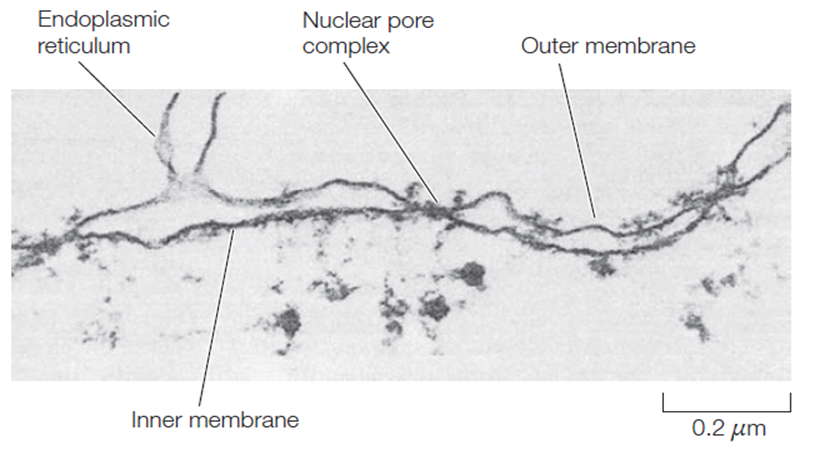
Two nuclear membranes, inner and outer nuclear membranes. Nuclear pore complexes, which allow the regulated exchange of molecules between the nucleus and the cytoplasm. Space between the inner and outer nuclear membranes is directly connected with the lumen of the endoplasmic reticulum. Outer nuclear membrane is functionally similar to the membranes of the endoplasmic reticulum, has ribosomes bound to its cytoplasmic surface
The critical function of the nuclear membranes is to act as a barrier that separates the contents of the nucleus from the cytoplasm. Each nuclear membrane is a phospholipid bilayer permeable only to small nonpolar molecules. Nuclear pore complexes—the sole channels through which small polar molecules and macromolecules pass through the nuclear envelope
Function: selective traffic of proteins and RNAs between the nucleus and the cytoplasm.
Underlying the inner nuclear membrane is the nuclear lamina, a filamentous meshwork that provides structural support to the nucleus
The nuclear lamina is composed of 60- to 80-kilodalton (kd) fibrous proteins called lamins
The lamins bind to specific inner nuclear membrane proteins, such as emerin and the lamin B receptor, and are directly connected to the cytoskeleton by protein complexes (called LINC complexes)

The nuclear pore complex
The nuclear pore complexes are the only channels through which small polar molecules, ions, and macromolecules (proteins and RNAs) can travel between the nucleus and the cytoplasm
•The nuclear pore complexes -molecular mass of approximately 120 million daltons in human
Consist of about 30 different pore proteins (called nucleoporins or NUPs)
Function-RNA, transcription factors transport from nucleus to cytoplasm
Small molecules and some proteins with molecular mass less than approximately 40 kd diffuse freely through the pore in either direction
Most proteins and RNAs, however, pass through the nuclear pore complex by a selective transport process.
The nuclear pore complex consists of an assembly of eight spokes arranged around a central channel
The spoke–ring assembly is anchored within the nuclear envelope at sites of fusion between the inner and outer nuclear membranes
Protein filaments extend from both the cytoplasmic and nuclear rings, forming a distinct basketlike structure on the nuclear side
The central channel is lined by proteins called FG-NUPs because they contain repeats that are rich in phenylanine and glycine residues
The FG-NUPs are the barrier to permeability of the pore and facilitate regulated transport between the nucleus and the cytoplasm.

Nuclear basket


Functions
It contains the genetic information of the cell in the form of deoxyribonucleic acid (DNA) or chromosomes and thus, controls cell growth and multiplication. It is also the site of DNA replication (formation of an identical copy of DNA).
It regulates cell metabolism by synthesizing various enzymes.
It is the site for the synthesis of ribonucleic acid or RNA that acts as a template for the synthesis of various proteins in the cell. It is also the site for the synthesis of the protein factories of the cell called the ribosomes.
