
POPULATION:
Population attributes:
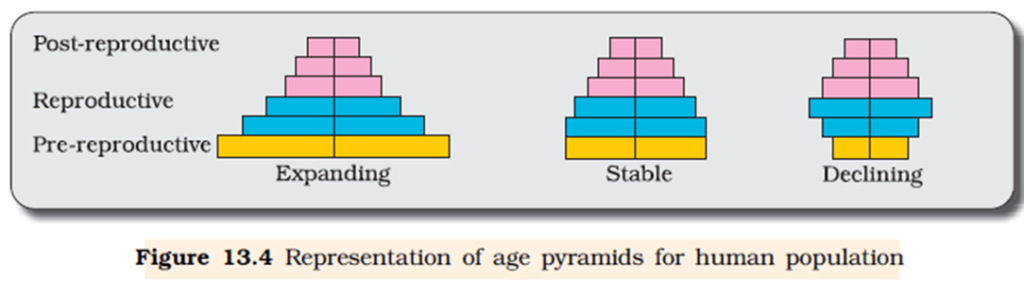
Population: a group of individual living in a well defined geographical area, share or compete for similar resources, potentially interbreed. Birth rate and death rate refers to per capita births and deaths respectively. Another attribute is sex ratio. The ratio between male female in a population. If the age distribution is plotted for a population the resulting structure is called age pyramid. The shape of the pyramids reflects the growth status of the population like growing, stable or declining. The population size is more technically called as population density.
Methods for measurement of population density:
⚫Counting the number
⚫Percent cover
⚫Biomass.
⚫Pug marks and fecal pellets for tiger census.
Population growth:
⚫The size of the population changes depending on food availability, predation pressure and reduce weather.
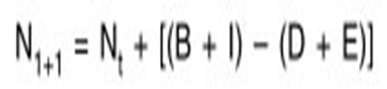
⚫Population size fluctuated due to changes in four basic processes, two of which (Natality and immigration) contribute an increase in population density and two (mortality and emigration) to a decrease.
⚫Natality: number of birth in given period in the population.
⚫Mortality: number of deaths in the population in a given period of time.
⚫Immigration: is the number of individuals of same species that have come into the habitat from elsewhere during a given period of time.
⚫Emigration: number of individuals of the population who left the habitat and gone elsewhere during a given time period.
⚫ If ‘N’ is the population density at time ‘t’, then its density at time t + 1 is :

Exponential growth
⚫The Exponential growth equation is Nt = N0ert
⚫Nt = Population density after time t
⚫N0 = Population density at time zero
⚫r = intrinsic rate of natural increase
⚫e = the base of natural logarithms (2.71828)
Exponential growth (‘J’ shape curve is obtained).
When resources are not limiting the growth.
Any species growth exponentially under unlimited resources conditions can reach enormous population densities in a short time.
Growth is not so realistic.

⚫Logistic growth model
Verhulst Pearl Logistic Growth is described by the following equations
dN/dt = rN (K–N / N)
Where N = Population density at time t
r = Intrinsic rate of natural increase
K = Carrying capacity
Logistic Growth (Sigmoid curve is obtained)
⚫When responses are limiting the Growth.
⚫Resources for growth for most animal populations are finite and become limiting.
⚫The logistic growth model is a more realistic one.
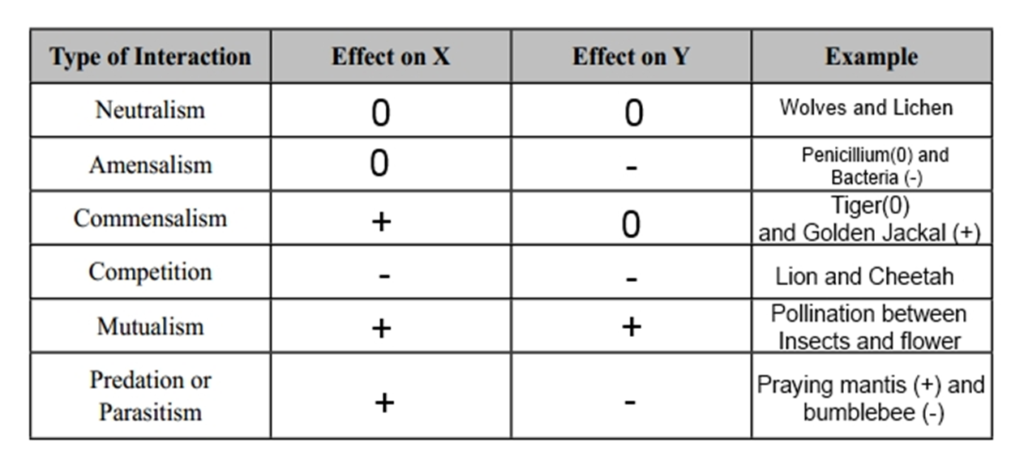
POPULATION INTERACTIONS:
Predation:
⚫Organism of higher trophic level (predator) feeds on organism of lower trophic level (prey) is called the predation.
⚫Even the herbivores are not very different from predator.
⚫Predator acts as a passage for transfer of energy across trophic level.
⚫Predators keep prey populations under control.
⚫Exotic species have no natural predator hence they grow very rapidly. (prickly pear cactus introduced in Australia created problem)
⚫Predators also help in maintaining species diversity in a community, by reducing the intensity of competition among competing prey species. (Pisaster starfish field experiment)
Defense developed by prey against predators:
Animals:
⚫Insects and frogs are cryptically coloured (camouflaged) to avoid being detected by the predator.
⚫Some are poisonous and therefore avoided by the predators.
⚫Monarch butterfly is highly distasteful to its predator (bird) due to presence of special chemical it its body. The chemical acquired by feeding a poisonous weed during caterpillar stage.
Plants:
⚫Thorns in Acacia, Cactus are morphological means of defense.
⚫Many plants produce and store some chemical which make the herbivore sick if eaten, inhibit feeding, digestion disrupt reproduction, even kill the predators.
⚫Calotropis produces poisonous cardiac glycosides against herbivores.
⚫ Nicotine, caffeine, quinine, strychnine, opium etc. are produced by plant actually as defenses against the grazers and browsers.
Competition
Interspecific competition is a potent force in organic evolution. Competition generally occurs when closely related species compete for the same resources that are limiting, but this not entirely true:
Firstly: totally unrelated species could also compete for the same resources. American lakes visiting flamingoes and resident fishes have their common food, zooplanktons.
⚫Secondly: resources need not be limiting for competition to occur. Abingdon tortoise in Galapagos Islands became extinct within a decade after goats were introduced on the island, due to greater browsing ability.
⚫Competitive release: A species, whose distribution is restricted to a small geographical area because of the presence of a competitively superior species, is found to expand its distributional range dramatically when the competing species is experimentally removed.
Connell’s elegant field experiment showed that superior barnacle Balanus dominates the intertidal area and excludes the smaller barnacle Chathamalus from that zone.
⚫Gause’s ‘competitive Exclusion Principle’: two closely related species competing for the same resources cannot co-exist indefinitely and the competitively inferior will be eliminated eventually.
Resource partitioning: If two species compete for the same resource, they could avoid competition by choosing, for instance, different times for feeding or different foraging pattern.
MacArthur showed five closely related species of warblers living on the same tree were able to avoid competition and co-exist due to behavioral differences in their foraging activities.
Parasitism
Parasitic mode of life ensures free lodging and meals. Some parasites are host-specific (one parasite has a single host) in such a way that both host and parasite tend to co-evolve.
Parasitic adaptation includes
⚫Loss of unnecessary sense organs.
⚫Presence of adhesive organs or suckers to cling on to the host.
⚫Loss of digestive system.
⚫High reproductive capacity
⚫Parasites having one or more intermediate host or vectors to facilitate parasitisation of its primary host.
⚫Liver fluke has two intermediate hosts (snail and a fish) to complete its live cycle.
Effects on the host:
⚫Parasite always harms the host.
⚫They reduce the survival, growth and reproduction of the host.
⚫Reduce its population density.
⚫They make the host more vulnerable to the predators, by making it physically weak.
Ectoparasite: feeds on the external surface of the host.
⚫Lice on human
⚫Ticks on dog
⚫Marine fish infested with copepods
⚫Cuscutaa parasitic plant grow on hedge plants.
Endoparasites: are those that live inside the host body at different sites.
⚫Life cycle is more complex.
⚫Morphological and anatomical features are greatly simplified.
⚫Highly developed reproductive system.
Brood parasitism:
⚫Special type of parasitism found in birds.
⚫The parasitic birds lay its eggs in the nest of its host and let the host incubate them.
⚫The egg of the host is very similar with the egg of the host.
⚫Cuckoo lays eggs in the nest of the crow.
Commensalism:-
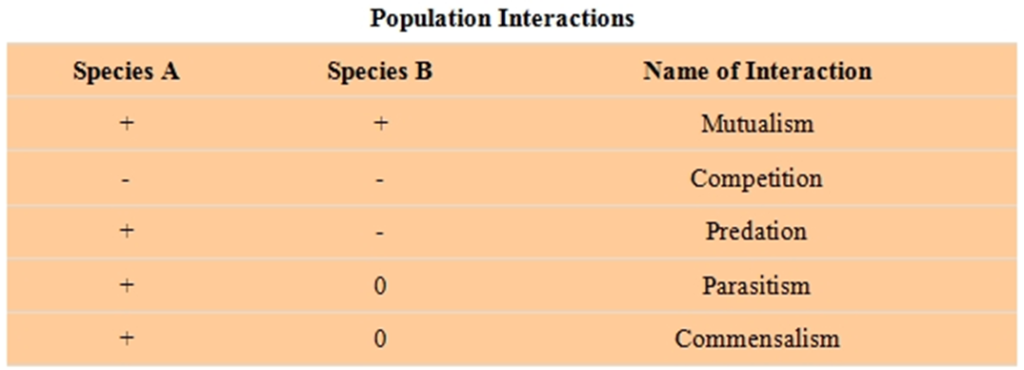
⚫This is the interaction in which one species benefits and the other is neither benefited nor harmed.
⚫Orchids growing as an epiphyte on a mango branch.
⚫Clown fish living among tentacles of sea anemone.
⚫Barnacles on back of whales.
⚫Cattle Egret and grazing cattle.
Mutualism: Interaction between two living organism, both are equally benefited, no one is harmed.
⚫Lichen: a mycobiont and a Phycobiont.
⚫Mycorrhiza: relationship between fungi and root of higher plant.
⚫Pollinating insects and flowering plants.
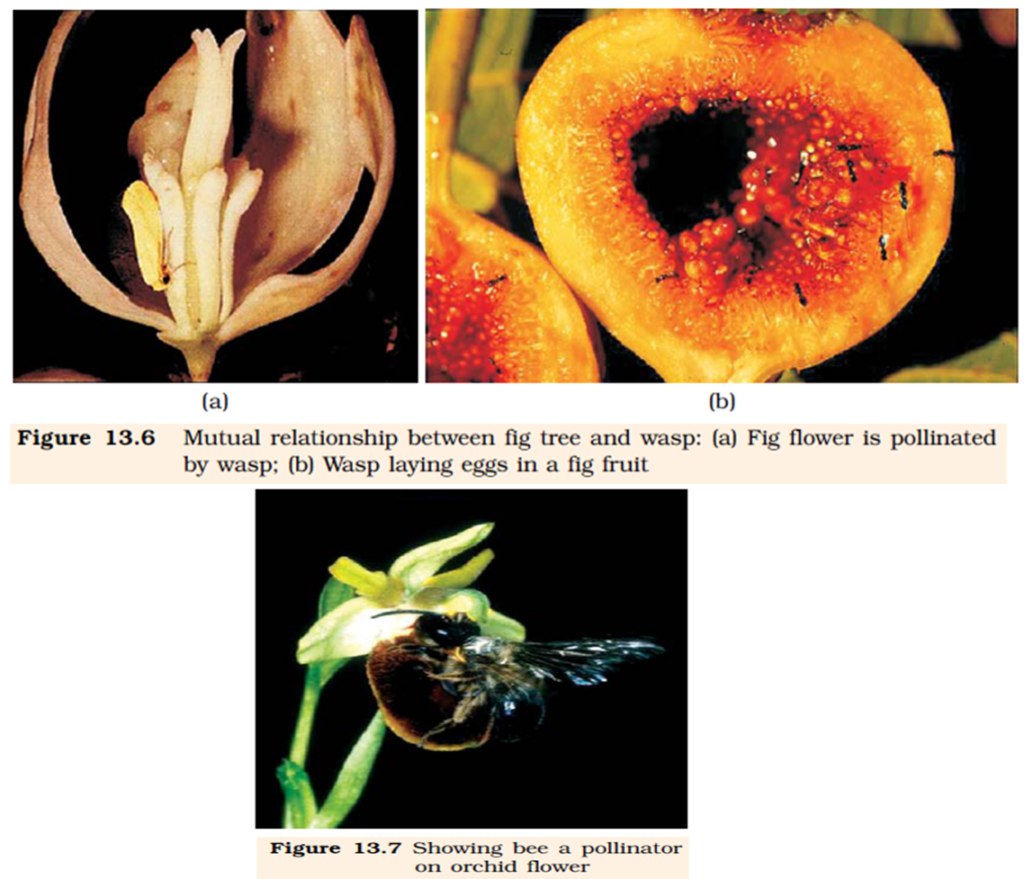
⚫Fig trees and its pollinating agent wasp.
Sexual deceit
⚫Mediterranean orchid Ophrys employs ‘sexual deceit’.
⚫Petal of the flower resembles the female bee.
⚫The male bee attracted to what it perceives as a female, ‘pseudocopulates’ with the flower but does not get any benefits.